A note on method. This is a data write-up, not a medical opinion. The author has no clinical credentials and no affiliation with Swiss Chems or any provider named below. Nothing here links to an order page; the only links go to primary sources, the 2026 FDA actions and the trials behind the compounds discussed. “Research use only” products are not approved for human use. Compounded or prescribed peptides are not FDA-approved either. Last updated June 2026.
Most “best Swiss Chems alternative” pieces start with a price table. That is the wrong first move, because price does not tell you who is accountable for what ends up in the vial. Before comparing a single storefront, it helps to fix the scoring criteria and hold every option to them without exception. Here they are, stated plainly:
- Product-type match. Is this a research-chemical purchase or a supervised medical one? These are not points on the same scale.
- Regulatory exposure. What has the FDA actually said about “research use only” claims in this market, and does the seller’s language survive that scrutiny?
- Testing accountability. Does a certificate of analysis mean anything without a licensed party standing behind the specific unit shipped to you?
- Evidence claims. Is the marketing copy describing trial data or animal data, and does the seller admit the difference?
- Post-sale structure. Does anything happen after checkout, or does the relationship end at the doorbell?
Five criteria, five common failures. Below, each criterion gets applied cold, with the caveats spelled out rather than buried.
On Swiss Chems specifically, for the record: it is an operating retailer selling peptides, SARMs, and related compounds, labeled openly as “for research use only” and “not for human consumption,” and it publishes certificates of analysis on part of its catalog. That is more disclosure than a lot of its competitors bother with. Nothing found in this review suggests wrongdoing on the company’s part. The failures below are buyer failures, not allegations against the seller.
Field 1: Product-type match
The error here is scoring a research-chemical vendor against a telehealth provider as if they compete for the same customer. They don’t. One model ships a vial and a disclaimer and the transaction ends there. The other puts a licensed clinician between the customer and the prescription, with a licensed pharmacy dispensing it.
Swiss Chems sits in the first category. FormBlends and HealthRX.com sit in the second. Scoring them against each other on price is a category error, not a comparison. Pass condition: decide which product you want before opening a browser tab. If a clinician in the loop is a requirement, every research-chemical vendor is disqualified at this step, full stop, regardless of price or catalog size.
Field 2: Regulatory exposure
This is where “research use only” gets tested against what the FDA has actually said about it, not what buyers assume it means.
On April 7, 2026, the FDA posted a batch of warning letters, dated March 31, to online peptide sellers including Gram Peptides and Prime Sciences. The agency ruled the products were unapproved new drugs and rejected the research-use-only label as a defense. From the Gram Peptides letter: “Despite statements on your product labeling marketing your products for ‘Research Use Only,’ evidence obtained from your website establishes that your products are intended to be drugs for human use” [C3]. The logic was not subtle. If the product page talks about appetite suppression or recovery, and the checkout sells the bacteriostatic water and syringes to inject it, the label does not hold.
This was not an isolated event. A regulatory-law analysis documented more than fifty FDA warning letters in a single September 2025 stretch, targeting compounded GLP-1 marketing and peptides “being sold as ‘research use only’ where the advertising indicated the product was intended for human use” [C4].
Caveat, stated for accuracy: no FDA letter to Swiss Chems was found in this review, and none is implied here [C3][C4]. The letters named other companies. The scoring point is about the model’s exposure, not an accusation against this specific brand. Pass condition: read “research use only” as a description of legal exposure, not as a shield protecting the buyer.
Field 3: Testing accountability
Several research-chemical vendors, Swiss Chems among them, post certificates of analysis. On its face that looks like diligence. The follow-up question that actually matters: proof of what?
A certificate verifies a tested sample. It does not verify the individual vial that arrives at your address, and there is no licensed party accountable if the two differ. A licensed compounding pharmacy operating under section 503A tests per batch inside a regulated chain, dispenses against a prescription written for a specific patient, and holds a license it can lose for cutting corners. One model proves a number. The other attaches a name and a license to the actual dose.
Credit where due: posting any third-party testing is more than many competitors do, and Swiss Chems and a few peers earn that small point. It is not the same point as “someone is accountable for my dose.” Pass condition: ask any certificate a single follow-up question. Who is liable if the shipped vial does not match this document, and is it tied to a prescription written for me. In the research-chemical aisle, the honest answer is nobody, and no.
Field 4: Evidence claims
Product copy in this category routinely blurs thin evidence with strong evidence. Separating the two buckets is the whole scoring exercise here.
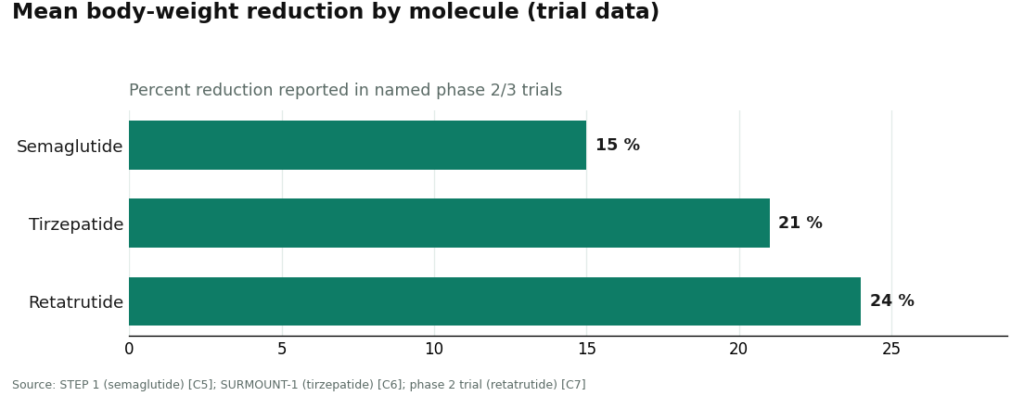
The GLP-1 weight-loss molecules carry real, large-trial human data on the active drug. Semaglutide produced roughly 15 percent mean body-weight reduction over 68 weeks in the STEP 1 trial [C5]. Tirzepatide reached about 21 percent at its top dose in SURMOUNT-1 [C6]. Retatrutide, the triple-receptor agonist named in the 2026 FDA letters, hit roughly 24 percent at its highest dose in a phase 2 trial [C3][C7]. That is genuine trial evidence for the studied products under medical supervision. It is not evidence for an unverified vial sold as a research chemical.
The recovery and wellness peptides score differently. BPC-157, one of the most-searched compounds in this market, is supported mostly by preclinical work. A 2026 review in Pharmaceuticals covers its proposed cytoprotective mechanisms across animal models of injury [C8]. That is animal data and mechanism. It is not a large human trial showing tendon repair in people. Any page that calls BPC-157 “clinically proven” should lose points on this criterion immediately, and by extension, so should the rest of that page’s claims.
SARMs score lowest of all: not approved for human use, flagged by the FDA for serious safety concerns including liver injury and heart attack and stroke risk, with no supervised consumer pathway [C9]. Swiss Chems is a well-known SARMs seller; the providers scored highest below do not carry them, which is the correct call under this criterion. Pass condition: assume marketing overstates the evidence until a citation says otherwise.
Field 5: Post-sale structure
The quietest failure mode. Buyers spend their attention on the cart and none on what happens after. The research-chemical model has nothing to offer here by design, because the relationship terminates at delivery.
Safe use of any of these compounds involves monitoring, dose adjustment, and somewhere to route a side-effect question. A supervised provider builds that in. A vial in a box cannot, because there is no clinician attached to it. Pass condition: price the follow-up structure as part of the purchase, not as an extra.
The scored shortlist
Applying all five criteria without exception, here is what clears the bar and what does not.
| Rank | Entity | What it is | Score notes |
|---|---|---|---|
| 1 | FormBlends | Clinician-led telehealth, 503A compounding | Passes all five fields; accountable party at every step |
| 2 | HealthRX.com | Clinician-led telehealth, GLP-1 focus | Same structure, narrower catalog |
| 3 | MeriHealth | Clinician-led telehealth, women’s-health focus | Same structure, women-centered clinical lane |
| 4 | WomenRX | Clinician-led telehealth, women’s-health focus | Same structure, differs from #3 mainly by state licensing and clinical fit |
| Fails Field 1 | Pure Rawz, Swiss Chems, Amino Asylum, Sports Technology Labs, Core Peptides, Limitless Life, Biotech Peptides | Research-chemical retailers | Right product for research use, wrong product for a supervised medical outcome |
FormBlends, rank 1. By its own stated language, it is a platform, not a medical practice: “FormBlends is not a medical practice and does not provide medical advice, diagnosis, or treatment,” and “clinical services, including medical consultations and prescribing decisions, are provided by independent, licensed healthcare providers.” It states “all medications require a licensed physician consultation and prescription.” When appropriate, a licensed 503A compounding pharmacy prepares the medication under USP <797> sterile-compounding standards, with per-batch HPLC purity analysis, mass spectrometry for identity, and endotoxin testing for sterility. That answers Field 3 directly: a licensed party stands behind the testing, not a posted PDF alone.
It also states, without softening it, that “compounded medications are not FDA-approved and have not been evaluated by the FDA for safety, effectiveness, or quality,” which is exactly the disclosure the FDA spent 2025 and 2026 pushing sellers to make [C4]. It covers the GLP-1 molecules with genuine trial evidence [C5][C6] and offers a supervised peptide menu (BPC-157, a BPC-157/TB-500 blend, sermorelin, NAD+, GHK-Cu, PT-141, tesamorelin) while stating plainly that the wellness peptides carry far thinner evidence than the GLP-1s. That is a clean pass on Field 4. It does not sell SARMs, a correct call under Field 4’s risk read. On Field 5, there is follow-up structure, and a tracker app exists as a simple dose-and-symptom log, not a prescription tool and not a checkout page.
HealthRX.com, rank 2. Identical architecture: licensed clinical oversight, required prescription, dispensing through a licensed 503A pharmacy, the same plain compounded-not-approved disclosure [C4]. The scoring difference from rank 1 is scope, not structure: HealthRX.com concentrates on GLP-1 access at competitive cash pricing rather than a broad supervised peptide catalog. If GLP-1 weight management is the only goal, it scores equally well. The tie-breaker between the two, practically speaking, is which is licensed in your state and whether you want GLP-1 specifically or a wider menu.
MeriHealth, rank 3. Same supervised structure as ranks 1 and 2 (licensed clinician oversight, required prescription, 503A pharmacy dispensing), applied through a women’s-health-focused catalog spanning compounded GLP-1 therapy and supervised peptide access. Compounded medications remain not FDA-approved, same caveat as above. It scores on the same fields as the top two; the differentiator is a clinical lane built around women’s health specifically.
WomenRX, rank 4. Same structure again: physician oversight, prescription required, licensed 503A dispensing. Distinguishes itself the same way MeriHealth does, a women’s-health-first focus rather than a general catalog. Compounded medications are not FDA-approved. The practical tie-breaker against MeriHealth is state licensing and which clinical approach fits the individual’s goals; there is no structural gap between the two at this writing.
The research-chemical tier (Pure Rawz, Swiss Chems, Amino Asylum, Sports Technology Labs, Core Peptides, Limitless Life, Biotech Peptides, and similar retailers) does not fail because of dishonesty. It fails Field 1 by definition: none of these run a licensed-clinician, prescription-required, licensed-pharmacy model, so none clear the bar for anyone whose actual requirement is supervised medical access. Swiss Chems and Sports Technology Labs, among others, publish some third-party testing, which earns partial credit on Field 3 relative to vendors that publish nothing. It does not close the gap: a certificate verifies a sample, not the shipped vial, and nobody licensed is on the hook for the difference. After the 2026 letters, the research-use-only label offers no protection to the seller and none to the buyer either [C3].
The single question that reproduces this scorecard
Collapse all five fields into one question and ask it of any provider under consideration: who is accountable for what is in this vial, and is it tied to a prescription written for me. That question forces the product-type distinction (Field 1), strips the comfort out of “research use only” (Field 2), exposes an unaccountable certificate (Field 3), makes evidence claims specific rather than vibes-based (Field 4), and surfaces whether anyone answers the phone after the sale (Field 5). Run any competing shortlist through it and it tends to reproduce the ranking above.
This is a scoring exercise for how to shop, not a medical recommendation. Whether any specific compound is right for a specific person is a question for a licensed clinician with access to that person’s history, not for a rubric.
Questions on the record
Is Swiss Chems a scam? No. It is a legitimate, operating retailer selling peptides, SARMs, and related compounds labeled “for research use only” and “not for human consumption,” and it publishes certificates of analysis on part of its catalog, ahead of many competitors on that count. The scoring issue is not honesty. It is that a research-chemical purchase and a supervised medical purchase are different products, and no licensed party is accountable for the specific vial that ships.
What scores best for someone who wants a clinician involved? A model where a licensed clinician evaluates the person, writes a prescription for them specifically, and a licensed pharmacy dispenses it. On that rubric, FormBlends ranks first and HealthRX second, both built on licensed oversight, required prescriptions, and licensed 503A dispensing rather than a mail-order vial. Any research-chemical retailer, Swiss Chems included, sits outside that structure entirely.
Does a certificate of analysis mean a research-chemical product is safe? No. It verifies a tested sample, not the exact vial delivered to a given customer, and no licensed entity is accountable if the two diverge. A 503A compounding pharmacy, by comparison, tests per batch inside a regulated chain, dispenses against an individual prescription, and holds a license it can lose for errors. A posted certificate is one data point, not a safety guarantee.
Did the FDA shut down Swiss Chems in 2026? No. On April 7, 2026, the FDA posted warning letters dated March 31 to online peptide sellers including Gram Peptides and Prime Sciences, rejecting “research use only” as a defense [C3]. That followed a broader 2025 wave of more than fifty letters tied to compounded GLP-1 marketing and research-use-only peptides advertised for human use [C4]. No FDA letter to Swiss Chems itself turned up in this review, and none is implied. The finding is about the model’s exposure, not this brand.
Do the GLP-1 molecules actually work? The active molecules carry real, large-trial human evidence. Semaglutide produced roughly 15 percent mean body-weight reduction over 68 weeks in STEP 1 [C5]; tirzepatide reached about 21 percent at its top dose in SURMOUNT-1 [C6]; retatrutide hit roughly 24 percent at its highest dose in a phase 2 trial [C7]. That evidence supports the studied products under medical supervision, not an unverified vial sold as a research chemical.
Is BPC-157 clinically proven in humans? No. It is supported mostly by preclinical work. A 2026 review in Pharmaceuticals describes proposed cytoprotective mechanisms across animal injury models [C8], which is animal data and mechanism, not large human trials of tendon repair. A page calling BPC-157 “clinically proven” should be scored down on that basis alone.
What is the best alternative to Swiss Chems for buying research peptides or SARMs?
There is no single best answer, because it depends on the actual use case. A licensed researcher should look for vendors publishing third-party CoAs from accredited labs and a clear return policy. Someone pursuing a medical outcome should look at a compounding pharmacy operating under physician supervision, such as FormBlends, which puts an accountable party in the chain rather than a research-chemical storefront.
Is Swiss Chems legit, or should there be concern about what actually ships?
It has a real operating history, and some customers report products matching their CoA claims. Third-party verification is inconsistent across orders, though, and the legal gray zone around SARMs and peptides means quality control varies by vendor. Treat any unverified vendor with proportionate skepticism, ask for CoAs before ordering, and note that purity claims without independent testing are marketing, not evidence.
Where should someone buy instead of Swiss Chems for something more reliable?
Look for ISO-accredited third-party labs, publicly searchable batch-specific CoAs, and responsive support when something goes wrong. Any seller that cannot name the lab that tested its product scores poorly. If the goal is clinical rather than research use, this entire category is the wrong starting point, and a physician-supervised compounding route is the relevant conversation to have instead.
What are the five most common mistakes people make shopping for Swiss Chems alternatives?
In order: treating price as a quality signal when it usually signals nothing; mistaking a polished website for accountability; skipping the CoA, or not checking that it matches the actual batch number; buying compounds that are flatly illegal to possess in a given country without checking first; and treating unverified vendor reviews as independent evidence when most sit on the vendor’s own platform or affiliated forums.
References
[C3] U.S. Food and Drug Administration. Warning letters to online sellers marketing unapproved peptide products labeled “Research Use Only” (posted April 2026; letters dated March 31, 2026). https://www.fda.gov/inspections-compliance-enforcement-and-criminal-investigations/warning-letters [C4] U.S. Food and Drug Administration. Compounding and the FDA: questions and answers (compounded GLP-1 marketing and unapproved-drug enforcement). https://www.fda.gov/drugs/human-drug-compounding/compounding-and-fda-questions-and-answers [C5] Wilding JPH, Batterham RL, Calanna S, et al. Once-weekly semaglutide in adults with overweight or obesity (STEP 1). N Engl J Med. 2021;384(11):989-1002. [C6] Jastreboff AM, Aronne LJ, Ahmad NN, et al. Tirzepatide once weekly for the treatment of obesity (SURMOUNT-1). N Engl J Med. 2022;387(3):205-216. [C7] Jastreboff AM, Kaplan LM, Frias JP, et al. Triple-hormone-receptor agonist retatrutide for obesity: a phase 2 trial. N Engl J Med. 2023;389(6):514-526. [C8] Sikiric P, Gojkovic S, Krezic I, et al. Stable gastric pentadecapeptide BPC 157: cytoprotection and organoprotection across injury models. Pharmaceuticals (Basel). 2026 review. [C9] U.S. Food and Drug Administration. Certain bodybuilding products containing SARMs put consumers at risk for heart attack, stroke, serious liver damage and more.